Our Services
Full Coverage Across
Every Stage of Production
Four service categories built to protect product quality and reduce supply-chain risk — from raw materials to container loading.
Inspection
Inspection Services
On-site product inspections conducted at every critical stage of the production cycle — from raw material intake through finished goods and container loading. Each inspection follows AQL-based sampling methodology with photo documentation and structured reporting.
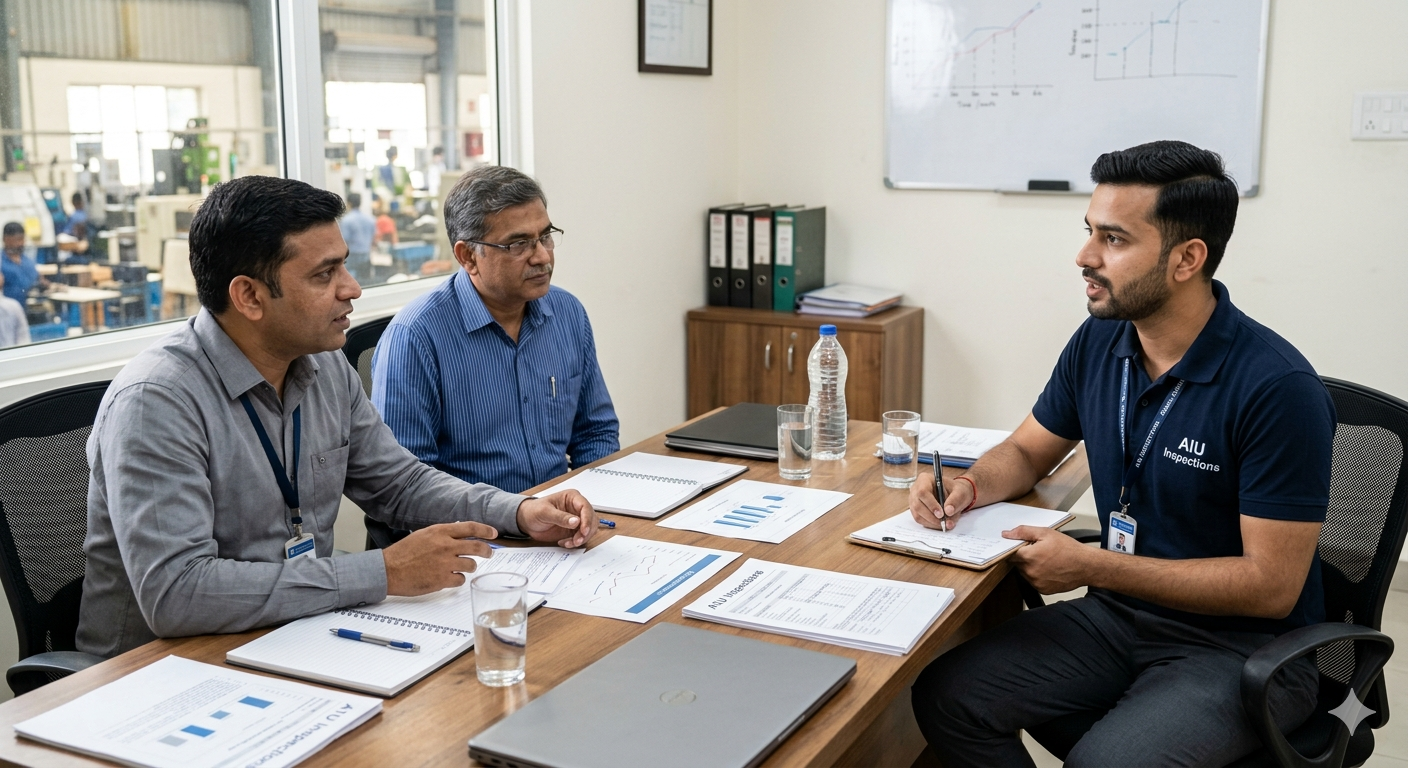
Initial Production Inspection
Verification at the start of production to confirm materials, components, and early output meet specifications before mass production proceeds.
Benefits
- Catch issues before they multiply across the full run
- Confirm raw materials match approved standards
- Verify factory setup and workforce readiness
Deliverables
- Structured pass/fail report
- AQL sampling results
- Photo documentation
- Risk summary
Quick Answers
When is the best time to book an IPI?
Book an IPI when the first 10–20% of your production run is complete and available for inspection. This gives you time to identify issues and implement corrections before the entire batch is manufactured.
What does an IPI report contain?
The report includes AQL sampling results, a photo log of materials and early-production units, measurement checks, defect classification, and a clear pass/fail recommendation.
Can an IPI replace a Pre-Production Meeting?
No — a Pre-Production Meeting (PPM) happens before production starts, while an IPI verifies the first physical output. The two services complement each other and are often booked together.

Raw Material Inspection
Inspection of incoming raw materials and components for conformity before they enter the production line.
Benefits
- Prevent non-conforming materials entering production
- Reduce downstream defect rates
- Confirm supplier material certifications
Deliverables
- Material conformity report
- Lab submission recommendation (where applicable)
- Photo documentation
Quick Answers
Which raw materials can you inspect?
We inspect fabric rolls, trim components, packaging materials, hardware, zippers, buttons, and any other input that enters the production line — for both softlines and hardlines.
Can the RMI result trigger a lab test?
Yes. If on-site checks raise concerns about fabric weight, composition, or chemical compliance, our inspector will collect sealed samples for forwarding to an accredited laboratory under our Sample Picking for Lab (SPL) service.
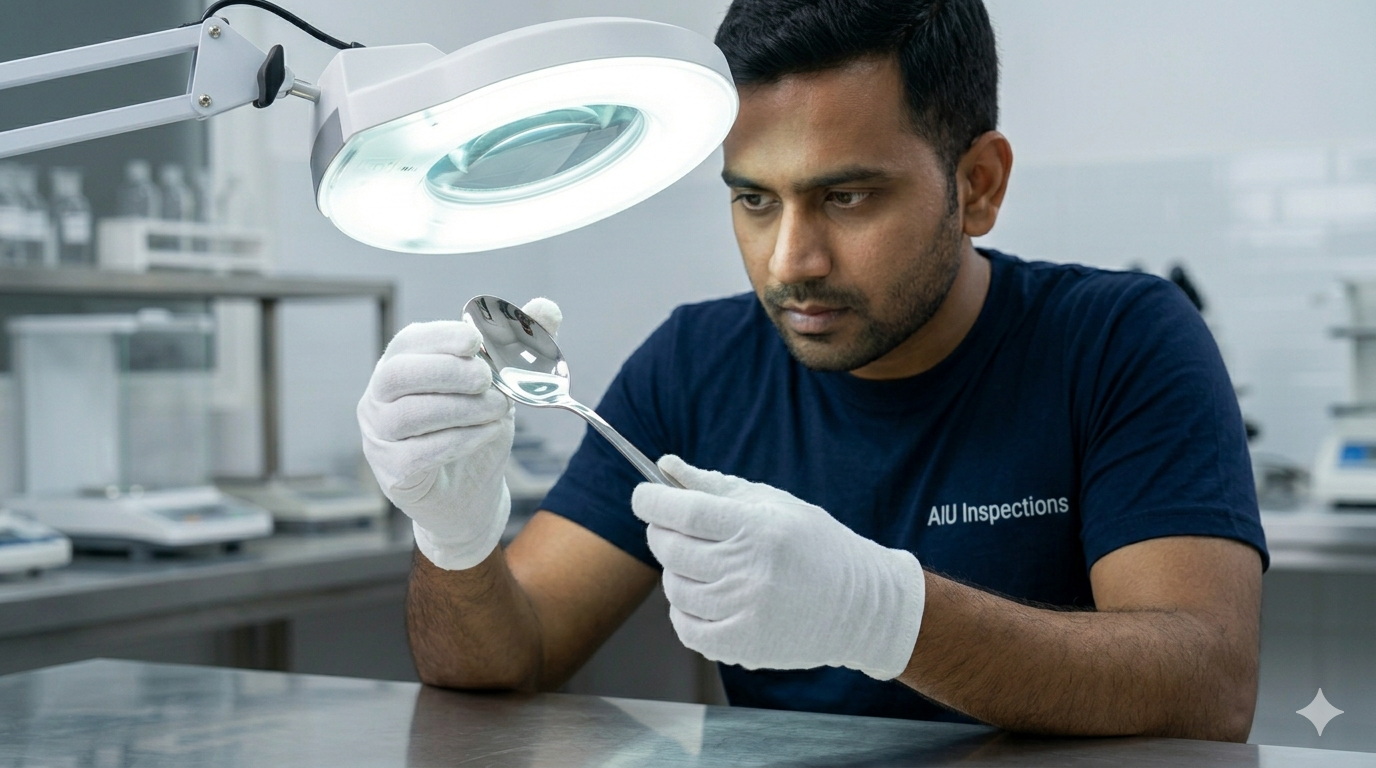
Sample Picking for Lab
Independent third-party collection of production samples from the factory before dispatch, specifically for submission to accredited laboratories for testing.
Benefits
- Prevents factory-selected (biased) samples
- Maintains chain of custody
- Supports accredited lab testing programs
- Reduces compliance risk
Deliverables
- Sample collection report
- Chain of custody documentation
- Photo evidence
Quick Answers
Why use a third party for sample picking?
Factories sometimes submit their best-performing units ('golden samples') to labs, which do not reflect actual production quality. An independent AIU inspector selects samples randomly and seals them on-site, ensuring the lab receives a true production representative.
What chain-of-custody documentation do you provide?
We provide a signed sample collection report, tamper-evident sealing evidence, and photo documentation confirming the samples were drawn directly from the production batch.
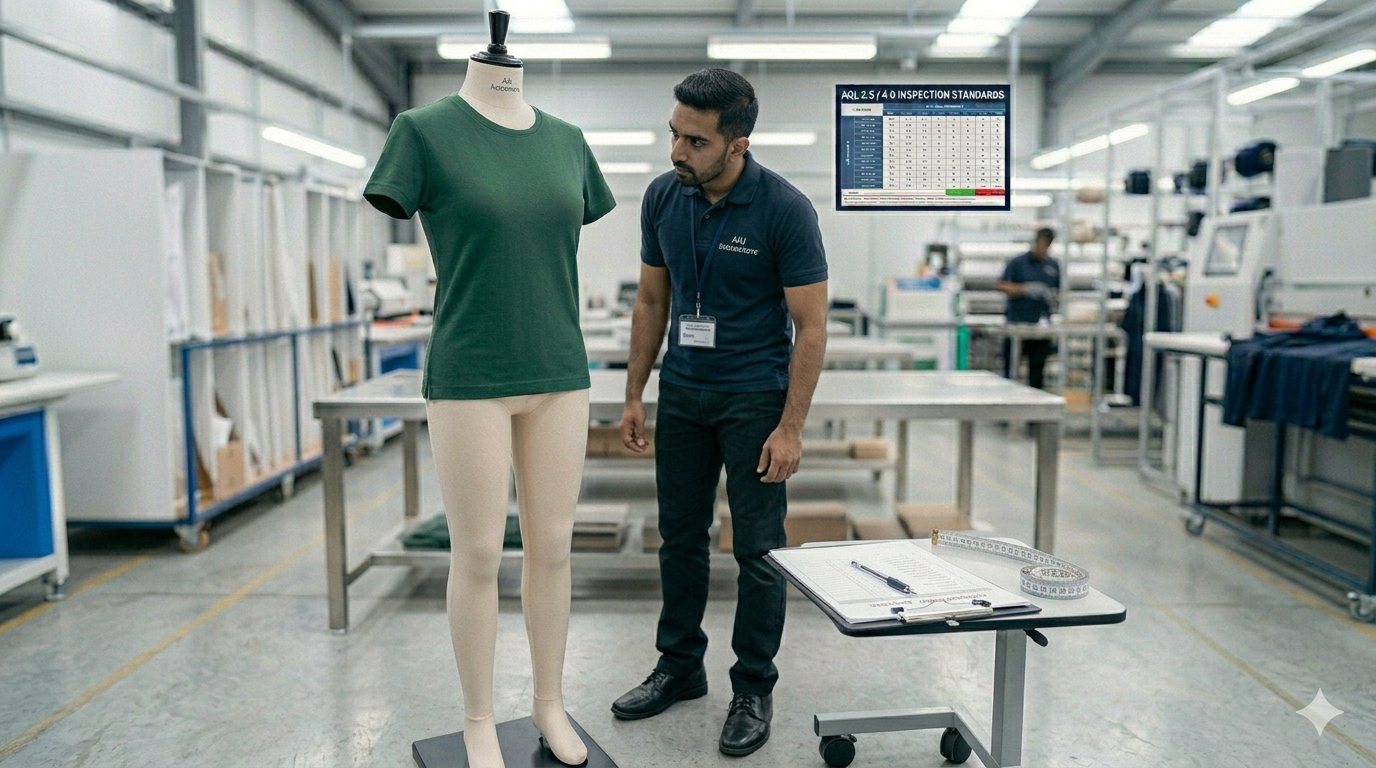
Sample Validation
Verification and evaluation of submitted samples against approved specifications, buyer requirements, reference samples, or standards.
Benefits
- Confirms samples match approved specs
- Validates against reference samples
- Catches deviations before bulk production
- Documented, evidence-based result
Deliverables
- Sample validation report
- Conformity assessment vs. reference
- Photo evidence
Quick Answers
What sample types does sample validation cover?
We validate proto-samples, fit samples, size-set samples, counter-samples, and pre-production samples — evaluated against your approved tech pack, reference sample, and buyer specification sheet.
What is the difference between Sample Validation and a Pre-Production Meeting?
A PPM aligns the factory team on production requirements before cutting starts. Sample Validation evaluates a physical sample against documented specifications. Both are pre-production tools that serve different verification stages.
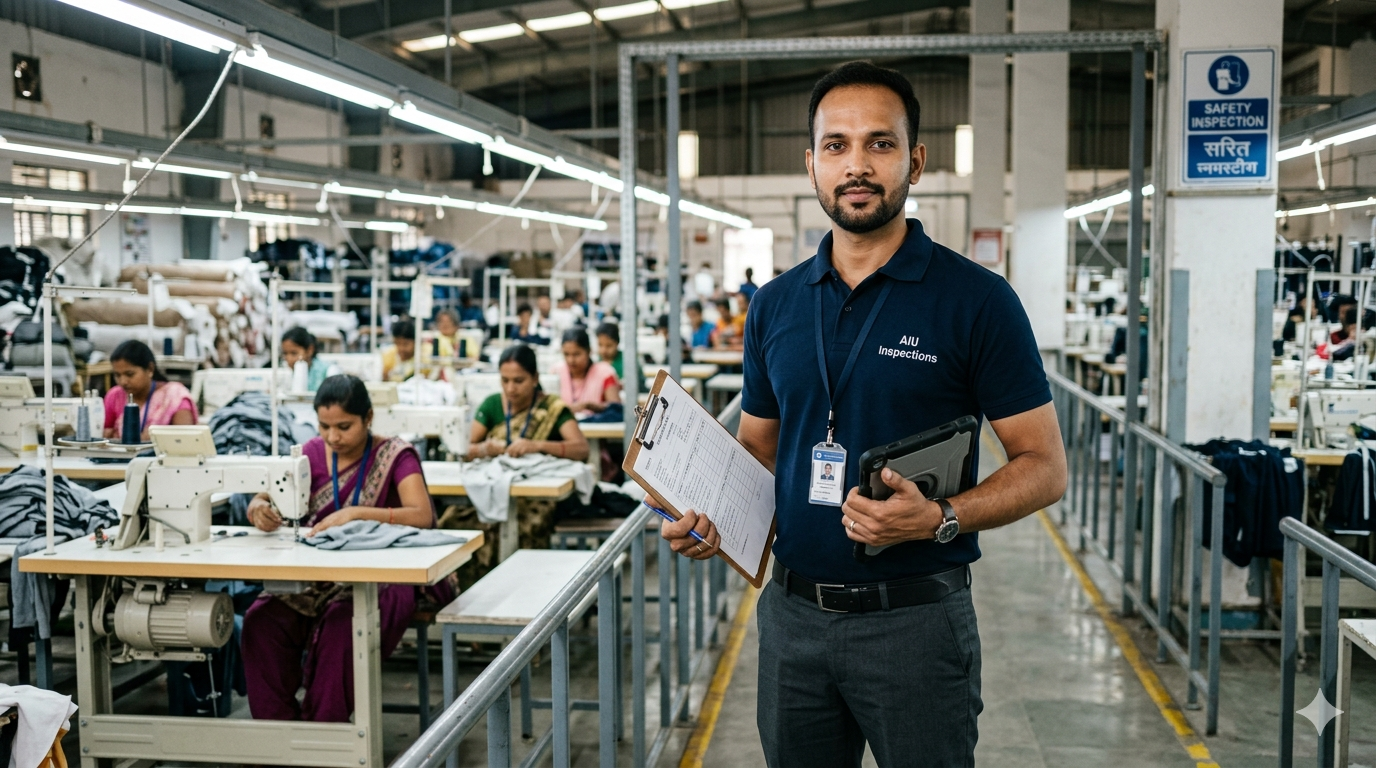
During Production Inspection
Mid-production check (typically 20–60% complete) to identify quality issues early and allow corrections before the bulk of production is complete.
Benefits
- Early defect detection — before it's too late to correct
- Real-time production quality feedback
- Reduces final inspection failures
Deliverables
- DUPRO report with findings
- AQL results
- Corrective action recommendations
Quick Answers
At what production completion percentage should a DUPRO be conducted?
Typically at 20–60% completion — early enough that defects can still be corrected on the running production batch, but late enough that the factory's actual output is representative.
What if defects are found during a DUPRO?
Our inspector documents findings in real time, presents them to the factory during the on-site closing meeting, and issues a corrective action recommendation. If the issue is structural, we recommend an IPI or re-inspection after corrections are made.
Can a DUPRO substitute for a Final Random Inspection?
No. A DUPRO checks mid-production quality but does not replace the AQL-based random sampling of finished, packed goods that an FRI provides. We recommend both for high-risk or high-value orders.
Inline Inspection
Quality checks performed along the production line at defined process points to monitor workmanship and output quality in real time.
Benefits
- Continuous quality monitoring
- Immediate feedback to production team
- Reduces end-of-line failures
Deliverables
- Inline report per checkpoint
- Defect classification summary
Quick Answers
How is inline inspection different from a DUPRO?
A DUPRO is a periodic batch check at a defined production milestone. Inline inspection is a continuous, line-side monitoring service — our inspector is present on the production floor checking each process point as it runs.
Which product categories benefit most from inline inspection?
Garment manufacturing, footwear assembly, and bag construction — processes with multiple sequential workmanship steps where defects compound quickly if not caught at source.
Final Random Inspection
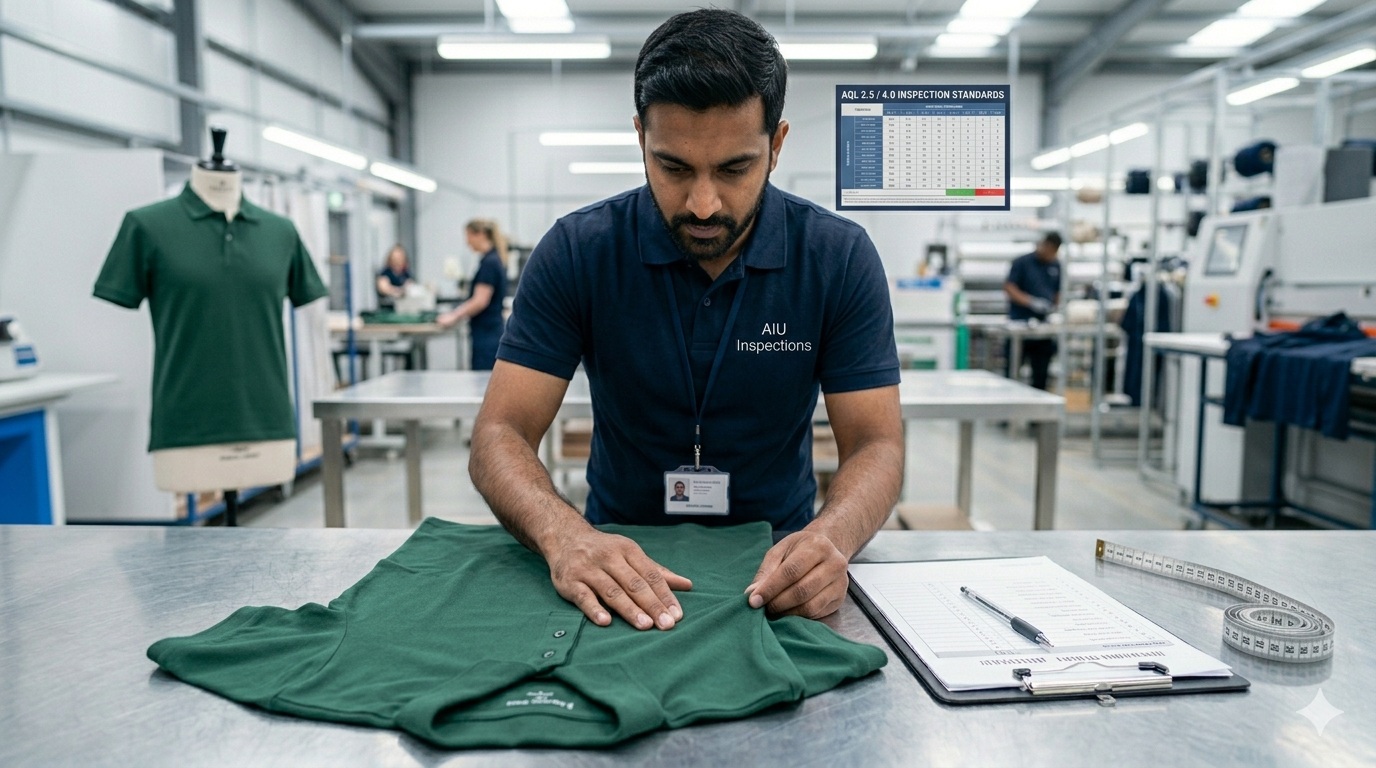
AQL-based random sampling of finished, packed goods to confirm overall lot quality before shipment.
Benefits
- Prevents non-conforming shipments
- Industry-standard AQL methodology
- Clear pass/fail decision for shipment release
Deliverables
- Final inspection report
- AQL sampling table
- Defect summary
- Pass/fail verdict
- Photo documentation
Quick Answers
What AQL level do you use for Final Random Inspections?
We default to AQL 2.5 for major defects and AQL 4.0 for minor defects (ISO 2859-1 / ANSI/ASQ Z1.4 General Inspection Level II) — the global retail standard. We can apply any custom AQL parameters your buyer specifies.
When should the FRI be booked?
When at least 80–100% of production is complete and goods are fully packed into export cartons. We need finished, packaged product to draw an accurate AQL random sample.
What is the turnaround for an FRI report?
All AIU inspection reports are delivered within 4 hours of inspection completion, including the FRI. The report includes the AQL table, defect log, photo evidence, and a clear pass/fail result.

Container Loading Supervision
Supervision of quantity count, packaging condition, and correct loading during container stuffing.
Benefits
- Verify shipped quantity vs. PO
- Confirm cargo condition before sealing
- Loading photo documentation
Deliverables
- Loading report with photos
- Quantity verification
- Container seal number
Quick Answers
What does Container Loading Supervision cover?
Our inspector verifies the quantity loaded against the packing list and purchase order, checks carton condition, confirms correct product and style placement, and records the container seal number — with photo documentation throughout.
Can CLS be combined with a Final Random Inspection?
Yes — this is a common booking. The FRI confirms product quality on the last day of production, and CLS is booked for the loading day. Together they provide end-to-end pre-shipment assurance.
Audit
Audit Services
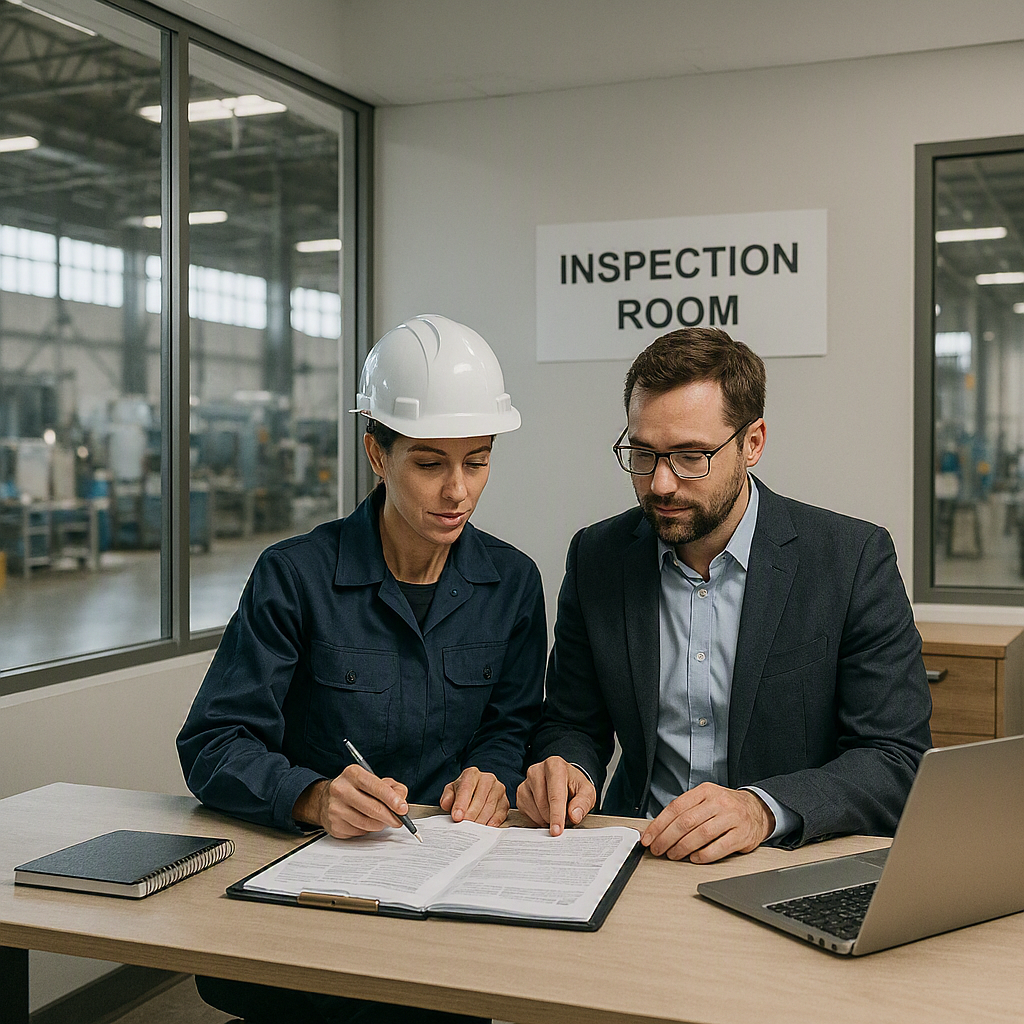
Comprehensive factory and compliance audits that assess suppliers against defined capability, technical, and social standards. Audit findings are scored, documented, and supported by corrective action recommendations.
Factory Capability Evaluation Audit
Assessment of a factory's overall capability, production systems, quality management, and capacity to meet buyer requirements.
Benefits
- Evaluate factory before placing orders
- Identify capability gaps
- Benchmark supplier quality systems
Deliverables
- Scored audit report
- Non-conformity register
- Corrective action plan template
- Factory rating
Quick Answers
When should we conduct a Factory Capability Evaluation Audit?
Before placing your first purchase order with a new supplier, or periodically to re-evaluate a supplier's current capability after significant time has passed or major changes have occurred in their operations.
What scoring system do you use?
We use a weighted scoring framework across capability, quality management, infrastructure, and compliance dimensions — producing a numerical factory rating with a clear risk classification (Low / Medium / High).
Technical Audit
Deep assessment of factory technical processes, equipment, testing capabilities, and quality controls against defined technical criteria.
Benefits
- Verify technical capability claims
- Assess testing and measurement equipment
- Confirm process controls
Deliverables
- Technical audit report
- Equipment and process assessment
- Risk rating
Quick Answers
What is the difference between a Technical Audit and an FCEA?
An FCEA is a broad capability assessment covering production capacity, QC systems, and overall readiness. A Technical Audit goes deeper into specific process parameters, testing equipment calibration, and technical compliance against defined product standards.
Which industries benefit most from a Technical Audit?
Hardlines, footwear, bags, and any product category with material testing, performance, or safety certification requirements benefit most from a Technical Audit.
Social Compliance Audit
Assessment of factory working conditions, labor standards, and ethical compliance against defined social compliance criteria.
Benefits
- Manage ethical sourcing risk
- Support responsible sourcing programs
- Align with buyer code of conduct
Deliverables
- Social compliance audit report
- Non-conformity register
- CAPA recommendations
Quick Answers
Which compliance framework does your Social Compliance Audit follow?
We align our social compliance assessments with the core standards of major international frameworks (including SA8000 principles and buyer codes of conduct). We can also audit against your brand's specific supplier code.
What happens if serious non-conformities are found?
Critical non-conformities (e.g., underage labor, forced labor, structural safety hazards) are flagged immediately in the audit report. We issue a detailed CAPA plan and can schedule a follow-up verification audit to confirm remediation.
Qap
Quality Assurance Programs
An end-to-end quality management program that combines inspections, audits, and corrective action management across your supplier base — building a continuous quality system rather than a series of one-off checks.
Program Modules
- 1Factory Capability Evaluation Audit
- 2Pre-Production Meeting (PPM)
- 3Size Set Review
- 4Pre-Production Audit
- 5Incoming Quality Control
- 6Pilot Review
- 7Initial Production Inspection
- 8Production Monitoring
- 9During Production Inspection
- 10Pre-Final Audit
- 11Final Random Inspection
- 12Container Loading Supervision
- 13Root Cause Analysis
- 14CAPA Management
Quality Assurance Program
A fully structured, ongoing quality program customized to your product categories, supplier base, and risk profile. Combines multiple service modules into a coordinated quality system.
Benefits
- Single quality partner across all inspection touchpoints
- Consistent standards across all suppliers
- Trend data and supplier scorecards over time
- Proactive risk management vs reactive problem-solving
- CAPA tracking and verification built in
Deliverables
- Customized quality program scope
- All applicable inspection and audit reports
- Supplier scorecard and performance tracking
- CAPA management and verification
- Quarterly quality review summary
Quick Answers
Is the QAP suitable for brands with multiple suppliers?
Yes — the QAP is designed for brands managing a supplier base. It standardizes quality checkpoints across all suppliers and generates comparative scorecards so you can identify your strongest and weakest performing factories.
How is a QAP scoped and priced?
We work with you to define the exact service modules, frequency, and supplier list. Pricing is based on scope and volume — contact us for a customized program proposal.
Specialized
Specialized Quality Services
Targeted services that address specific quality challenges — from pre-production alignment and sample integrity to root cause analysis, corrective action verification, and quality training.
Pre-Production Meeting
Structured technical and quality review before bulk production begins to align factory and buyer on requirements, approved samples, and production risks.
Benefits
- Prevent misunderstandings before production starts
- Review approved samples vs. bulk standards
- Document agreed requirements formally
Deliverables
- PPM report
- Agreed-standards documentation
- Risk register
Quick Answers
Who attends a Pre-Production Meeting?
An AIU quality representative attends alongside the factory's production manager and relevant technical/sewing team leads. The buyer's tech pack, approved samples, and specification documents are reviewed together.
What is the output of a PPM?
A PPM report documenting agreed-upon production requirements, identified risk areas, and the action plan the factory commits to before cutting begins.
Root Cause Analysis
Structured investigation of a recurring quality failure to identify its true underlying cause and develop an effective corrective action.
Benefits
- Stop recurring defects at source
- Structured 5-Why or Fishbone methodology
- Forms basis for effective CAPA
Deliverables
- Root cause analysis report
- Contributing factors
- Recommended corrective actions
Quick Answers
What methodology does AIU use for Root Cause Analysis?
We deploy structured 5-Why analysis and Fishbone (Ishikawa) diagrams to trace defects to their operational root causes — distinguishing between material issues, process failures, and human factors.
Can an RCA be conducted remotely?
The most effective RCAs are conducted on-site at the factory where the defect occurred. Remote RCAs based on report data and supplier input are possible but less comprehensive.
CAPA Verification
On-site verification that agreed corrective and preventive actions have been effectively implemented by the factory.
Benefits
- Confirm CAPA is real, not just documented
- Close quality issues with evidence
- Maintains supplier accountability
Deliverables
- CAPA verification report
- Photo evidence
- Pass/fail closure decision
Quick Answers
How long after a CAPA plan is issued do you verify it?
Typically on the next factory visit — either a follow-up inspection or the next scheduled production check. Timing depends on how quickly the factory can realistically implement the corrective measures.
What counts as verified CAPA closure?
Photo evidence of the corrective change implemented on the production line, re-tested product samples if applicable, and a signed factory confirmation — all documented in the CAPA verification report.
Supplier Performance Evaluation
Periodic evaluation of supplier quality performance over time, feeding the supplier scorecard and informing sourcing decisions.
Benefits
- Objective supplier performance data
- Trend visibility across inspection cycles
- Supports vendor rationalization decisions
Deliverables
- Supplier performance scorecard
- Trend analysis
- Improvement recommendations
Quick Answers
How often should a Supplier Performance Evaluation be conducted?
We recommend quarterly evaluations for active suppliers, and annually for lower-frequency suppliers. The scoring feeds into your supplier tier system to inform sourcing decisions.
Quality Consulting
Advisory services on quality system design, inspection program structure, supplier development, and quality risk management.
Benefits
- Expert guidance without full-time hire
- Program design from practical experience
- Customized to your sourcing model
Deliverables
- Consulting report or recommendations
- Program framework
- Implementation roadmap
Quick Answers
What does a Quality Consulting engagement typically cover?
We work with your team to design or improve your inspection program, establish internal quality standards, develop supplier onboarding checklists, and build a defect classification library suited to your product categories.
Quality Training
Training programs for buyer teams and factory quality staff on inspection methodology, AQL standards, defect classification, and quality management.
Benefits
- Upskill internal quality teams
- Align factory quality staff to buyer standards
- Reduce inspection failures through better factory understanding
Deliverables
- Training session delivery
- Training materials
- Competency assessment (optional)
Quick Answers
Who is quality training designed for?
Both buyer-side teams (merchandisers, QC managers, sourcing leads) and factory-side QC staff. We tailor the curriculum to the audience's role and product category.
Coverage
Industries We Serve
12+ years of factory-floor experience across the product categories your brand depends on.
Apparel & Garments
Woven, knitwear, denim, sportswear, workwear
Home Textiles
Bedding, towels, cushions, curtains, table linen
Footwear
Shoes, sandals, boots — all construction types
Bags & Luggage
Handbags, backpacks, travel luggage, accessories
Hardlines & Household
Kitchenware, homeware, tools, stationery, décor
Corporate & Promotional
Branded merchandise, gifts, event merchandise
FAQ
Frequently Asked Questions
Everything you need to know about our inspection and audit services.
What geographical regions in India do your 3rd party inspection services cover?
We provide comprehensive, pan-India coverage across all major manufacturing clusters. Our localized inspectors are strategically positioned across the country for rapid deployment, including Northern India (Delhi NCR, Noida, Gurugram, Panipat), Western India (Mumbai, Ahmedabad, Surat), Southern India (Tirupur, Coimbatore, Chennai, Bangalore, Hyderabad), and Eastern India covering major industrial and manufacturing hubs like Kolkata and Ranchi. This minimizes travel expenses and ensures native language proficiency on factory floors.
How fast do we receive our digital inspection report?
AIU Inspections provides the fastest turnaround time in the TIC industry. We guarantee the delivery of your comprehensive, multi-point digital inspection report within 4 hours of inspection completion. Every report undergoes an objective internal technical review before being uploaded directly to your portal, complete with high-resolution photo evidence, measurement evaluations, and clear pass/fail metrics.
How does AIU differ from conventional third-party inspection agencies?
Legacy agencies treat inspection as a one-time static check, reporting defects without investigating why they happened. AIU operates on a continuous improvement loop. Beyond documenting errors, we identify the operational root causes and actively verify the factory's Corrective & Preventive Actions (CAPA). We don't just report on a bad batch; we help your suppliers fix their lines so your next production run comes out cleaner.
What happens during the 12-step AIU standard inspection methodology?
Every assignment follows a rigorous, transparent pipeline to ensure total consistency. This includes an initial Code of Ethics Agreement, on-site documentation and purchase order cross-referencing, physical quantity counts, retail packaging and barcode verifications, functional stress testing, dimensions/measurement verification, and a transparent draft findings meeting directly on the factory floor with the supplier to align on initial expectations.
Can you handle inspections across both softlines and hardlines?
Yes. Our founder-led team brings more than 12 years of factory-floor experience spanning multiple diverse product categories. Our specialized teams handle Softlines (woven garments, knitwear, denim, sportswear, home textiles, and footwear), Hardlines (household items, kitchenware, decorative goods, and stationery), and customized promotional or event merchandise for corporate brands.
What happens if an inspection fails? Do you help the factory fix the issue?
Unlike conventional agencies that simply hand over a failure report and walk away, AIU utilizes a proactive Quality Improvement Framework. If an inspection fails, we immediately initiate a Root Cause Analysis (RCA) to identify why the defects occurred. We then work collaboratively with the supplier to establish a clear Corrective & Preventive Action (CAPA) plan. On subsequent visits, our inspectors actively verify that these corrective adjustments have been effectively implemented on the factory floor so future production runs succeed.
How does AIU ensure the strict ethical conduct and integrity of its inspectors on-site?
Integrity is the absolute baseline of our business. Every single assignment begins with Step 1 of our methodology: a mandatory Code of Ethics Agreement. Our assessments are purely evidence-based and objective, completely insulated from any local factory or commercial pressures. We maintain zero-tolerance policies for non-compliance, ensuring that the data and images you see in your 4-hour report are a completely transparent, untampered reflection of your actual product quality.
Do you evaluate factories before we place an official purchase order?
Yes. To mitigate your upstream supply chain risks, we offer comprehensive Audit Services before you commit capital. Our Factory Capability Evaluation Audit (FCEA) and Technical Audits assess a supplier's genuine production capacity, machinery condition, technical systems, and quality control baselines. We also conduct Social Compliance Audits to ensure your suppliers adhere to ethical labor standards, protecting your brand reputation from structural risks.
At what stages of the manufacturing lifecycle can we book an AIU inspection?
We provide independent verification across the entire production timeline, including: Pre-Production — Raw Material Inspections (RMI) and Initial Production Inspections (IPI) to verify inputs before mass production starts. During Production — During Production Inspections (DUPRO) and Inline Inspections to catch defects while the machines are running. Pre-Shipment — Final Random Inspections (FRI) using AQL sampling standards once production is 80–100% completed. Logistics — Container Loading Supervision (CLS) to ensure products are securely packed and counted during port transit.
Can we track our suppliers' performance trends over time, or do you only provide individual reports?
Our digital vision is built around actionable analytics, not just static paperwork. Through our integrated platform approach, individual inspection insights feed into long-term tracking systems. We generate comprehensive Supplier Scorecards and monitor historical quality trends. This data lets you easily identify which factories are improving, pinpoint recurring defect patterns across your supply chain, and make highly informed, data-driven sourcing and procurement decisions.
Do you provide laboratory testing services alongside on-site visual inspections?
Yes, we offer Sample Picking for Lab Testing (SPL) as part of our core inspection services. To ensure complete testing integrity, our on-site inspectors independently select and seal random product samples directly from the factory floor using precise sampling protocols. These samples are then forwarded to accredited testing laboratories to verify chemical, material, or functional compliance, preventing factories from sending unrepresentative, hand-picked 'golden samples' to the lab.
What is an AIU Pre-Production Meeting (PPM), and how does it prevent manufacturing defects?
A Pre-Production Meeting (PPM) is one of our specialized quality services conducted right before a factory turns on its mass production lines. Our quality team reviews your technical packs, tolerance charts, and approved master samples side-by-side with the factory's production managers. By aligning on potential risk areas, stitching complexities, or material challenges before cutting begins, we help the factory establish tight internal controls to eliminate defects before they happen.
How does your internal review process ensure the total accuracy of your 4-hour inspection reports?
To maintain absolute precision, an AIU field inspector's on-site findings are not automatically finalized. Every draft report passes through Step 11 of our standard methodology: a strict Internal Technical Review. Our senior technical management team independently reviews the collected photo/video evidence, re-verifies all AQL mathematical equations, and checks for data consistency before the report is formally approved and released to your customer portal within the 4-hour window.
How does your Sample Validation Service (SVS) protect buyers prior to bulk fabric cutting?
Our Sample Validation Service (SVS) acts as a final gatekeeper for your design integrity. Our specialized team conducts an engineering-level evaluation of proto-samples, size-sets, or pre-production samples against your initial tech pack specifications. We verify fit, component quality, construction workmanship, and material weights so you can confidently greenlight mass production without risking bulk material waste.
How do manufacturers typically react to AIU inspections? Will it create friction with our suppliers?
Not at all. AIU operates on a philosophy of constructive collaboration, and suppliers deeply value our approach. Our objective is never to create artificial bottlenecks or look at factories as adversaries. We provide clear, objective, and evidence-based feedback on the factory floor during our closing meetings. By helping suppliers identify the operational root causes of recurring errors and providing actionable performance evaluation data, we help them strengthen their own manufacturing lines, creating a healthy win-win partnership for both buyers and suppliers.
What are AIU's Quality Assurance Programs (QAP), and how do they provide an all-round solution from factory evaluation to final dispatch?
Our Quality Assurance Programs (QAP) are structured, end-to-end quality management frameworks designed for brands looking for a comprehensive, all-round supply chain solution. Instead of treating quality as isolated, one-off checks, the QAP seamlessly integrates our entire suite of audits, inspections, root-cause engineering, and supplier development from the very beginning of the manufacturing lifecycle straight through to final cargo dispatch. Through this program, we Evaluate (via Factory Capability Evaluation Audits), Inspect & Monitor (across all raw material and production stages), Improve & Resolve (deploying and verifying CAPA on the factory floor), and Track (scoring supplier performance trends over time). This closed-loop program eliminates recurring defects and gives you complete, all-round transparency from the initial factory audit until the container doors are sealed for dispatch.
Ready to Strengthen Your Supply Chain?
Talk to our team about your inspection, audit, or quality assurance needs — no obligation.